Showing posts with label trees. Show all posts

Thursday, October 27, 2011

Riverside Rocks and a 10-minute challenge

Riverside Rocks
12x9 inches - pastel on Artagain
© S.Johnson
A studio piece, based on one of the photos taken from Baker's Bridge the other day.  I was really into these rocks with all their fissures and interesting textural things going on, and then of course, there was the amazing green water and reflections with the yellow cottonwoods.

The reflections on this were a bit tricky; the brown central area is actually a section of shallow water, but I don't know if it reads  properly or not.  I think I could finesse it a bit more.  And the photo did odd things to the greens used in the water, esp. the darker reflections in shadow - they are a darker turquoise and not the more saturated green in this photo.

I think the best part about doing this in my studio was that I had access to all of my pastels!  No having to make do with what was in my plein air box.   And, I was finally able to use some of these beautiful dark turquoise greens I bought a while back.

And, here is yesterday's painting, done as a warm-up for the painting above.  It's this week's DailyPaintworks challenge - a revisiting of the Ten Minute Challenge from earlier in the year.  You basically choose an object (and this is an apple, believe it or not) and divide your canvas into small sections and paint the object several times in 10-minute intervals.  Even with a 3x3" size per square, it's not as easy as you might think.  I did a pear last time, and it was a lot easier than this Gala apple.
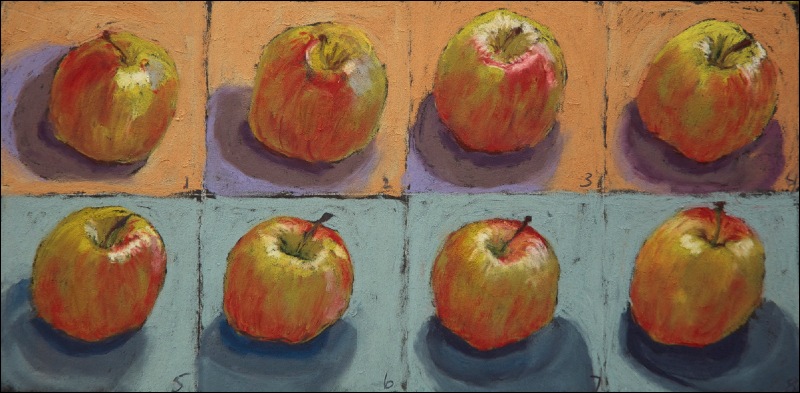
Apple Octet
6x9 inches

It's really funny having a partner around who isn't an artist and is totally comfortable being honest about  the paintings:  "the first one looks like an onion, and the 4th looks like a smashed pumpkin, and some look like they are rotting..."  Seriously, Wayne's comments make me laugh, and I know what someone will be getting in his Christmas stocking this year...

I tried to select accurate colors for everything prior to starting the painting, but you can see I sort of hosed it with the shadow colors on the first set of four.  By the 8th one, I was starting to get a bit better, and they are starting to look more like apples.   I just set the apple on a piece of Strathmore paper and rotated it under my studio lamp for each mini painting to get the differing shadows.

This is a great exercise, and I would encourage anyone who paints to try it, especially if you are trying to loosen up in your work.  Thanks so much for the challenge, Carol!


Monday, June 20, 2011

More outdoor pastels - ACEO, 16x12

After the recent plein air work I've been doing, I can't seem to find the desire to sit inside and paint, so today seemed like a good day to do some quickie florals and a tree sketch.  These are in the round brick wall garden located about 40' from the condo, in a grassy median strip on our street.  A large selection of marigolds, petunias and pansies were planted a few weeks ago, replacing the tulips that bloomed in early spring.

ACEO floral trio
2.5 x 3.5 inches each
pastel on black Strathmore

My pastel palette is lacking in saturated purples and violets needed to paint some of the flowers, but that will change in the next few days when the open stock pastel order I placed with Blick comes in.  I ordered over 60 pastels - mostly Mt. Visions, and a few Richeson Handmade - but I also ordered some of the Ludwig intense dark violets.  Almost every pastelist I know raves about these colors in particular, so I had to give them a try.   They are unlike anything in my current collection.  

And, then a study of this fascinating tree that is right across the street:

tree study
16x12 inches
pastel on Strathmore charcoal

It's nothing to write home about, but t'was good practice nonetheless.  The tree, in addition to having smooth white bark with the dark scarring, has these reddish strands of leaves(?) that hang down like thin fronds of hair.  It's quite remarkable, and very tall.  I have no idea of its identity.

-------
And, in keeping with tradition, here are some photos taken at Santa Rita Park, last weekend, in the community garden:

Yellow and pink columbine

Clematis


Pansies?

Purple & Blue - unidentified


Crimson and white columbine


Beautiful bi-color bearded iris


Monday, April 18, 2011

Spring comes to Durango - photo set

Some photos taken on a walk-about in downtown Durango yesterday - a placeholder until I have something new in my studio to share:

Detail of cherry blossom tree

Purple tulip with buds
Growing in a small retaining wall garden in the median right across from our new condo

Trees in bloom in downtown Durango

A trio of daffodils 

Flowering branch detail

Bi-color tulips 


Cherry tree at our current place

Enjoy!


Monday, April 11, 2011

The Tree x 4 - ACEO pastel landscape studies

Labels:  ACEO, original art, pastel painting, southwest landscape, tree, sunset
-----

Tree #1 - Yellow Sky & Red Wildflowers
 I seem to be in a bit of an indecisive artistic lull lately.  Can't decide what to do as far as larger works go; the idea of doing something big just seems daunting for whatever reason.

But yet, I still want to paint something.

So, I find myself coming back again to these little mini-paintings.  Not much to dedicate in the way of time or materials, which seems about right for me, at least today.

Tree #2 - Stormy Skies
South of Durango, along Hwy 550, is Florida Mesa.

And, along the highway is some farm or ranch land upon which resides a lone ponderosa pine in an open field.  I really dig this tree, and have photographed it on different occasions.

So, I decided to paint it and vary the background in each version.  This would actually be a great subject for a "Multiple Variations" challenge, similar to what jump-started me back to pastel painting 1 1/2 years ago with this series.


Tree #3 - Overcast Sky Sunset
 I may do more of The Tree, or not.  But, for tonight, it was good.

Tree #1 has maybe a bit of Tonalism to it?  All warm colors.

Tree #2 is similar to this one, based on a summer monsoon storm.

Tree #3 sports one of those intense sunsets with high-chroma colors, of which we have plenty of here.


Tree #4 was what tonight's sky looked like, sunset-wise.  Semi-plein air, I guess.
I guess until I have further inspiration to do a larger piece, these minis will tide me over.

I decided to add the black border around them using GIMP.  Looks neat, I think.

And, on an unrelated note, Blogger's formatting continues to confound me.  The text in Preview mode looks nothing like the actual blog post - large gaps between photos that I can't seem to fix.  So, sorry about that.


Friday, April 1, 2011

Redbud Tree - pastel, 11x14

Here's the bigger version of the ACEO:

Redbud Tree Along the Road
11x14 inches
pastel on 140# w/c paper with Golden pumice ground

I started this later in the afternoon, and worked on it for a few hours.  If nothing else, it was a good exercise in blocking in shapes and drawing trees.  The background?  Completely made up, evolving as things went along.  The original reference had a house and some other building maybe 50 ft. behind the tree, which wasn't at all what the painting is about, so they had to go. 

Simplifying it into a large meadow seems to work to keep the detail on the tree, and even more - its shadow.  I'm fascinated by the shadows cast by trees - they are always intriguing abstract shapes that are fun to look at and always a challenge to paint.   The road just got extended from a totally uninteresting driveway to something that perhaps leads to...the beach?  You, the viewer, get to decide where you go from here.  

I used warm, saturated vs. cool, grayed greens to manipulate the sense of distance here - one of the beauties of working in pastel is the scumbling and layering one can employ to obtain such effects.

Tomorrow, the road traveled will be a radical departure from this:  we are heading out early morning on an overnight trip in Bluff, UT.  Destination:  Butler Wash and Cedar Mesa - to spend 2 solid days hiking the area and see a tiny sampling of the hundreds of Anasazi cliff dwellings and rock art panels in the region.  One could literally spend a lifetime exploring the area, which is remote and literally off the beaten path.  This is a special trip, and I'm hauling my tripod along, which I normally don't do.  

Hopefully, I'll be able to get back to posting on Sunday.  Everyone enjoy your weekend!


-----
Last night's sunset; photos taken approximately 3 min. apart:


Tuesday, March 29, 2011

Spring trees in bloom - ACEO

tags:  eastern landscape painting - original pastel painting - for sale - redbud tree - dogwood tree - barns - magnolia - cherry tree
----
More ACEO-sized mini-pastels....for a new series on spring:

Redbud Tree
White Dogwood


Magnolia
Cherry Tree & Red Barn


During the time we lived in CT, my favorite season was, hands-down, the spring.   Around mid to late April, the land transformed from a dreary winter drab to acid greens of new leaf growth and blooming trees set forth to put on their show, and it was always exciting to see everything come to life again.  In our neighborhood, you didn't have to go far to find lots of different trees in festive spring blossoms.

But, they don't last...the magnolia trees are among the first to bloom, but they begin to drop their petals almost immediately, producing a carpet of creamy white below them.  This one was on a huge property right near downtown.  

I'd never seen redbud trees (I believe that is what this tree is) before moving to New England.  This particular tree was short and stocky, almost dwarf-like in its appearance.  I knew back when I took the reference photo last year I had to paint it.  It will likely be the first in a bigger size I do.

Dogwood trees are special to me.  I was born in MD, and although we moved to AZ when I was very young, I still have memories of them, and they are probably my favorite of the east coast trees.  Their graceful, curving branches always remind me of a Japanese painting.  

The cherry tree was situated on the corner of our street and New London Rd.  And, then there is the barn...an old, but well-maintained barn that I became quite fond of.  It is in many of my photos, and I was indeed lucky to get the photo of the tree in bloom with the barn.  The barn is an integral part of this image to me.

So, one or more of these will make it to bigger sizes, possibly in oils.  It's part of a series on spring I want to do.  

-------------

Cats are great to have around for their entertainment value.  Sometimes, Nelson forgets to put his tongue back in his mouth.  And, sometimes, I happen to get my camera before he remembers to.  It never fails to make us laugh.  


Tuesday, November 30, 2010

Tes Nez Iah Cottonwood - #41 FC-CP

Next in the Four Corners series is a view that is seen only a few seconds later on the drive, also along the edge of the Chinle wash.  Tes Nez Iah is a small populated area located along the wash; its name, meaning "tall cottonwoods" in Navajo, is a testament to the presence of water in this area.

Cottonwoods are one of my favorite trees, as I've probably mentioned before.  They have wonderful, organic shapes and defy any orderly arrangement of their trunks or branches.  They are a rich, vibrant in the spring and summer and turn a beautiful yellow in the fall.  I loved the juxtaposition of the two trees against the rising edge of the sandstone outcropping.  To me, it almost resembles a still life.

Tes Nez Iah Cottonwood
11x14
oil on canvas panel

Even though I'm posting this as "finished", I may go back and adjust a few things.  The photo had a small fence that ran to the edge of the cottonwood; I may go back and add it as I liked it, and possibly adjust the values on the tree a bit.  I attempted to make the greens of the shrubs/grasses different from those in the cottonwood in terms of temperature and value, but I'm not sure it's enough.  I also feel this needs clouds.  

Number 42 in the series - another 6x8 study - is fished, but I'll wait to post that tomorrow.  

Monday, August 23, 2010

Alpine Meadow - pastel

Here is today's painting, based on one of the many photos I took on our hike last week along the Colorado Trail, up by Molas Pass and near Molas Lake.  It starts around 10,000', so no pines, or even aspen - just spruce.  The trail heads east and drops down about 1700' to the Animas River, crossing the DSNGRR (Durango-Silverton narrow-gauge railroad).

"Alpine Meadow"
9x12" on Canson M-T

When in Telluride this past Friday, pastelist Bruce Gomez working on his easel right on the sidewalk in front of the gallery his work is sold in.  Of course, I couldn't help but stop and watch for a bit, as his work was stunning!   I asked him what surface he was painting on, as it had a sueded look, highlighting the luminescence of pastel.  He said:  "Watercolor paper sanded with #80-grit sandpaper".  No underpainting or anything.  He was using a 2" paintbrush from the hardware store to both blend the pastels and dust them off.  Have a look at his website to see his beautiful pastels.  

Anyway, that was inspirational, and I decided to try sanding some Canson paper to see if that helped.  The above painting is the result, and I have to say that it did definitely improve the surface and ability to apply more layers.  Earlier today, I went and purchased two sheets of 22x30" cold-press Arches watercolor paper to try as a surface; I'm always up for trying something new, and this is a fast (and cheaper) way to try a larger piece.  


Monday, July 12, 2010

Summer Field

A minor departure from the ocean/reflections theme here, although there will be another to post tomorrow.

This is from the monthly Spotlight Challenge on WC's pastel forum.  The subject for July is "trees", and I chose an image taken by the challenge host, Paula Ford, of a field in her state of TN.  I was drawn to its simple shapes and strong values.  

It's on the home-made surface of 140# watercolor paper and Golden fine pumice ground, untinted.  In lieu of that, I used an alcohol wash underpainting.  I was aiming for a more golden color, as shown in the underpainting, but it didn't work out that way.  This would be a reference that would lend itself to a series of paintings, actually....

"Summer Field"
11x15"
sold


underpainting

Sunday, May 16, 2010

Spring at Bluff Point - photo essay

Last November, one of my posts featured photos taken at one of my favorite places near where we live - Bluff Point State Park - and can be seen here.  I like it because it's one of the few places with wide-open space, which of course, appeals to my aesthetic sensibilities.   It has interesting shorelines, marshes, inlets, wildlife and things that make neat reflections in the water.  

Like fall in New England, spring - at least as far as the trees are concerned - transformation happens very fast.  The deciduous forests spend about 6 months without leaves, so once the chance of ice and snow is well past, they waste no time getting busy gathering energy from the sun while they can.  Once leaf buds start to occur, the process is like an explosion, and is pretty much complete within 2 weeks.   The leaves rapidly change from pale yellow and acid green to a deeper, more mature mixture of greens as the chloroplasts maximize the production of chlorophyll and other photon-capturing pigments needed for photosynthesis.

About two weeks ago, we decided to take advantage of the nice weather + weekend, and take a walk and photo shoot out along Bluff Point.  It was mid-afternoon, so not optimal conditions for excellent photos.  However, I did manage to take a few that turned out well enough to post here.  Others have far more value as a starting point for a painting.

Red Canoe
Sitting along the cove side of the Brushy Pt. barrier beach, this canoe patiently waits for its next seafaring adventure.

 
Seaweed 
These pieces of seaweed form interesting abstract shapes against the sand in this shallow section of the cove.


Coming Together
Wakes from this delightful pair of ducks form a circle in the still waters of the inlet of the Poquonnock River.


Reflections of Early Spring
This small barrier island, located on the breaker side of Brushy Pt.,  shows off its assortment of trees.  In the clear, shallow water of the foreground, clumps of dark seaweed sway with the ebb and flow of the tide.


Towards the Marsh
A marshy inlet and peninnsula form the backdrop for these strands of marshgrass and bright green shrub.

Side note: regarding future posts, I will probably have to stick with existing material for at least the next few days; yesterday, while we were out on a drive and photo shoot up some of the side roads, I was climbing up a short, grass-covered slope to get a better view of a field, when I slipped.  My camera swung forward and the edge of the lens hit a clump of grass, not even that hard.  However, it was enough to do something to the internal workings of the zoom mechanism, reducing the lens to a fixed 55mm.  That would have been acceptable, and I managed to take a few photos after that.   But, either due to me fiddling with it, or taking photos in the jammed position, the iris (?) is now partially closed.  So, it's hosed.  A new lens is in order, but I'm not going to get the same 18-55mm that came with the camera.  Time to move up to something better...and more durable!

I may have to go back to my trusty old 3MP Olympus PnS to take photos of paintings I do in the meantime.

Sunday, May 2, 2010

Celebrating the Tree: a photo-essay

Trees are what give personality to the landscape.  They add form, color and interest, and are appealing on many levels.  I find them similar to people in this regard, and just as I find a portrait of an individual person a far more compelling image than a crowd of people, so it is with trees.  Here in New England, trees are densely packed, like crowds of people, and cover the entire landscape except where their presence and location have been manipulated by man.  It's one of the things I've never gotten used to living here; the trees are everywhere and feel monotonous, smothering and induce a sense of claustrophobia in someone like myself who loves open space and big skies.  There is a loss of identity and uniqueness of the trees in these endless deciduous forests.

This post isn't about those kinds of trees.

During my time in AZ, on the various hikes and drives I went on, I was forever drawn to the arresting shapes of individual trees, often dead or in winter dormancy.  Whereas an entire forest of deciduous trees in winter, devoid of leaves, I find bleak and depressing, a single tree shows off its individuality and personality in this manner.  The unique forms of the trunk and branches, along with the color and texture of the bark and/or leaf foliage, are compelling, especially when combined with the elements of sky and land.

Here is a collection of images, taken over a period of 2 months, and in different locations, that focus on the form of the tree.  In all cases, I've adjusted the photo via various PP manipulations, to bring out the features.  The images span the range of genre - still life, landscape and abstract.

Tree Against Sky #1
The stark, curved branches of this dead tree reach up to a cloudless, sepia-toned sky along the Crest Trail in the Huachucas in mid-March.

Solo Tree with Clouds #1
The curving silhouette of this dead tree, located on the hillside of the Mule Mtns., contrasts with the direction of the clouds on this afternoon in early February in this black-and-white image.


Along FSR 62
This majestic scrub oak, a characteristic member of the chaparral biotic zone, welcomes drivers along the road east of the Santa Rita Mountains in this sepia-toned photo.  March '10.

Solo Tree with Clouds #2
Bands of horizontal clouds add a dynamic element to the vertical reaching branches of this tree, seen along the Deer Creek trail in the Mazatzal Mtns in this black-and-white photo.  February '10.


Tree Against Sky #2
The twisted branches of this tree, also seen along the Crest trail hike, seem to be gesturing towards the heavens.  An antiquing filter was applied to produce this selectively colored and desaturated effect.

Patterns
This AZ sycamore, located along a creek on the Mogollon Rim north of Payson, shows off its unusually colored and textured bark.  Mid-February.

Stirrings of Spring
This towering Fremont cottonwood, located along the Murray Springs/Clovis site trail in the San Pedro River Valley east of Sierra Vista, shows the first hint of the brilliant green foliage on its way in early March.

Thursday, April 8, 2010

A Trip to Buenos Aires National Wildlife Refuge

On Easter, I decided to head out in the early afternoon and go explore BANWR.  It is located southwest of Tucson, off of Hwy 286 about 58 miles, and isn't that well-known by Tucsonians, probably because it was only established as a wildlife refuge in 1985.  Since I'm trying to make the most of my remaining time here, it seemed like an interesting location to visit.  To learn more, here is the link to the website homepage .

The weather on Sunday afternoon was idyllic - sunny with highs in the low 70's.  The elevation of BANWR is a bit higher than Tucson, which made for a very comfortable outing.

Normally for this blog, my purpose is to post photos that I feel are the best of those taken at a given location or of a particular subject.  In this case, because of the time of the day, the photos aren't really that great - nothing I'd really consider worthy of printing and framing.  No beautiful clouds to add to the picture, or even a single photo of wildlife, most of which stays hidden during the day.  However, I decided to post some anyway, primarily to bring viewers along on my trip and hopefully give a sense of why I love hiking and exploring the areas of the southwest.

During my time in AZ, I've been driving a Buick Park Avenue, graciously lent by a family friend.  I ended up driving it down a dirt road that I located on my map that appeared to lead to the refuge's visitor center, located a few miles off Hwy 286.  What I didn't know was the condition of the road, which would have been perfect for my Jeep Wrangler, but not something I'd knowingly take a passenger car on.   It was an adventure, helped along by no cell phone coverage and not a single person or vehicle seen on the road.  A combination of luck and backcountry driving experience, and I was able to negotiate the Buick through unscathed.

A quick stop by the informative visitor's center, and then it was back up the highway and to the east to the small town of Arivaca, which is on the northeastern edge of the refuge property.  Along the way, I located the trailhead of one of the trails I'd read about on the website, so after getting gas and something to eat, I headed back to take the hike.

Below are a selection of photos from my trip.  Others I took will also no doubt become the subjects for future paintings.

Looking Back
This view to the northeast shows a curving section of the dirt road I'd just come along.  Looks fine in the photo, but it became gnarly as it crossed the small wash.   Isolated patches of Mexican poppies were found along these gently sloping hills and amongst the mesquite bosques.


Grassland and Baboquivari Peak
Taken just east of Hwy 286, this photo shows the characteristic grasslands of the refuge, and some of the ubiquitous Mexican poppies.  Baboquivari (pronounced "babbo-KEEV-uh-ree") Peak is considered sacred to the Tohono O'Odham people that live in the area; the mountain is actually located on their reservation to the west.


Fremont Cottonwoods in Arivaca Creek
To me, there are few things more visually stunning than a line of brilliant green (or yellow in the fall) cottonwoods lining a creek or river in the middle of the desert.  They, along with aspen, are my favorite trees.  This was taken along the creek (mostly dry) along the Mustang Trail I was hiking.  View is to the west.  AZ sycamore, back walnut, and other species of tree are also found in watershed areas such as this.


Arivaca Creek from El Cerro peak
I started this hike in the late afternoon, and this is 2.5 miles from the trailhead and perhaps 800' elevation gain.  This photo and the next were taken shortly before 6 p.m.  The trail was rough and rocky and a bit steep right at the end, but I'm a fast hiker and got up to the top in about an hour.  What a view - these images sum up why I hike.


Baboquivari from El Cerro
Another shot from the summit, this time looking to the northwest.


Sunset along the Mustang Trail
Taken on the way back down, this shows the warm glow of the late afternoon light has transformed Baboquivari Peak and its range into a simplified silhouette against the cloudless sky.  A variety of desert scrub, cacti and grasses make up the foreground.

Related Posts Plugin for WordPress, Blogger...